1906 Penny Errors and Varieties: What Actually Exists?
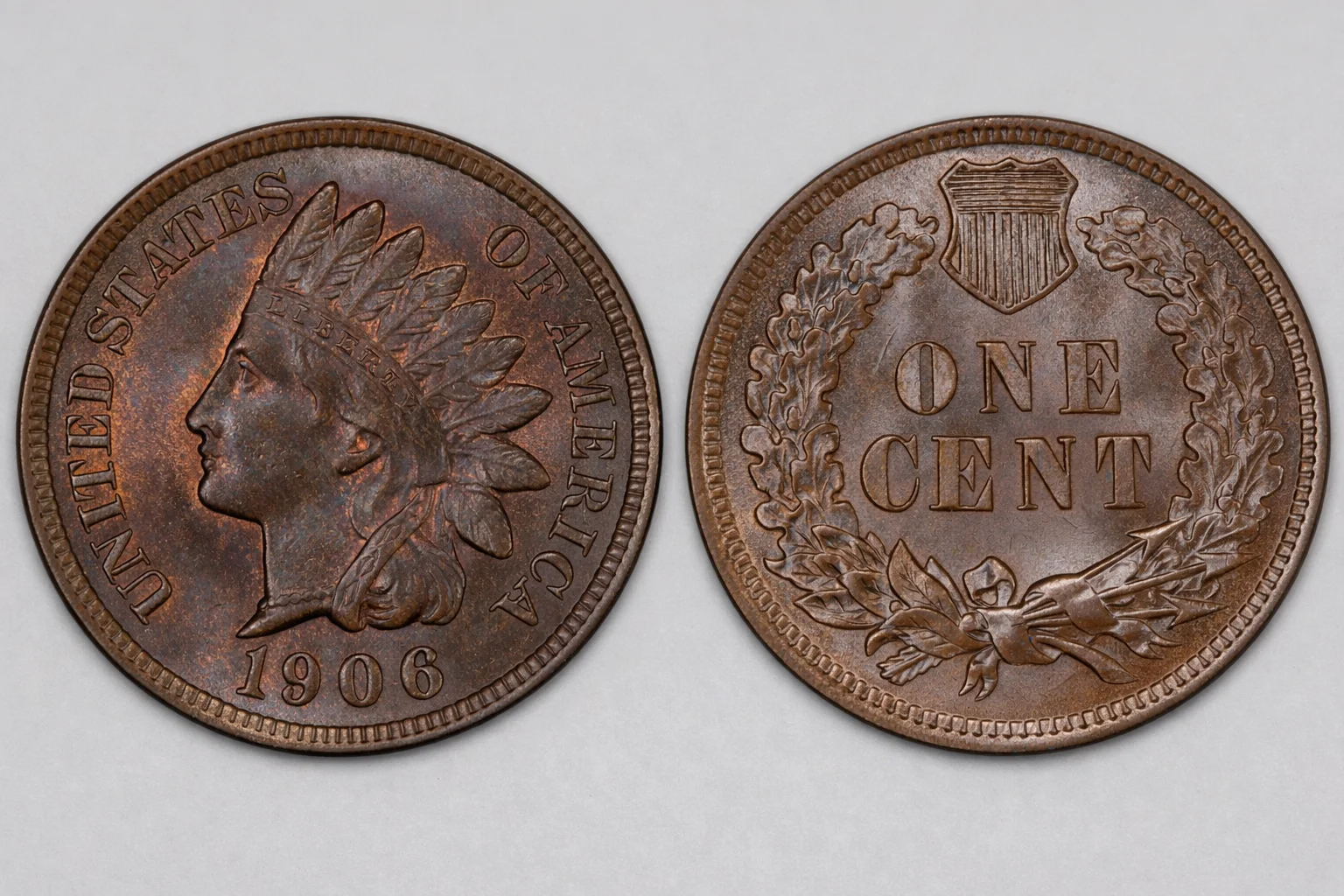
Collectors tend to believe that the 1906 Indian Head penny is a common late-date issue. With more than 96 million struck, it appears ordinary at first glance. In worn condition, it sells close to standard market levels.
Yet this year hides real mint errors and confirmed die varieties. A few are dramatic. Some are rare. The strongest examples sell far above the price of a typical circulated coin. Now, let’s talk about them.
Technical Background: Why 1906 Matters
The 1906 cent was struck only at Philadelphia. It carries no mint mark. Specifications are standard for late Indian Head cents:
Parameter | Specification | Notes |
Year | 1906 | Late stage of the Indian Head series |
Mint | Philadelphia | No mint mark used |
Series | Indian Head Cent (1859–1909) | Designed by James B. Longacre |
Composition | 95% Copper | Bronze alloy |
Alloy Balance | 5% Tin and Zinc | Hardening metals |
Weight | 3.11 grams | Standard for bronze cents |
Diameter | 19.05 mm | Same as a modern Lincoln cent |
Thickness | ~1.55 mm | Slight variation possible |
Edge | Plain | No reeds or lettering |
Metal Type | Bronze | Not pure copper |
Original Surface Color | Bright Red | When freshly struck |
Color Designations | BN / RB / RD | Based on surface preservation |
The alloy is bronze rather than pure copper. Over time, oxidation shifts surface tone from red to red-brown and eventually to full brown.
Large production numbers do not prevent mint errors. High output can increase die wear, repunching events, and strike-related issues. What ultimately defines rarity is survival and recognition, not mintage.
Errors You Can Consider to Buy
Off-Metal Strike: The Mexican Gold Planchet Case
The most dramatic known error for this date involves an off-metal strike on a Mexican 5 Pesos gold planchet. This is not a routine mint error. It is extremely rare.
Key characteristics:
Weight around 4.1 grams
Gold composition instead of bronze
Visible edge lettering from the host planchet
Distinct color and density
This occurred when a foreign gold blank entered the coining press and was struck with 1906 cent dies.
Such a piece is not simply collectible. It is museum-level material. Confirmed example is sold for five-figure sums. The rarity is extreme.
This is the highest-value error associated with the year.
Double Strikes and Flip-Over Errors
Double strikes occur when a coin fails to eject after the first strike and receives another blow. If the coin flips between strikes, the design appears distorted or partially overlapped.
On a 1906 cent, this can produce:
Offset date impressions
Twisted portrait outlines
Secondary rim formation
Value depends on visibility. A minor shift brings moderate interest. A dramatic second strike with clear separation commands stronger premiums.
Most verified examples trade in the hundreds of dollars. Severe flip-over errors can exceed that range.
These are genuine mint errors, not post-mint damage.
Die Cuds: Rim Break Varieties
A cud forms when a portion of the die breaks near the rim. The missing steel allows metal to flow outward, creating a raised blob on the coin.
On the 1906 cent, cuds appear:
Along the rim
Sometimes intruding into lettering
On the obverse or reverse
Small cuds carry modest premiums. Large, visually dominant breaks attract more attention.
Collectors look for: clean borders; undisturbed metal flow; no signs of tooling.
Prices range from minor premiums to several hundred dollars for large, well-defined examples. Cuds are confirmed die failures, not damage.
Repunched Date (RPD) Varieties
Before hubbing improvements, dates were punched into dies by hand. Multiple impressions sometimes occurred. This created repunched date varieties.
On 1906 cents, several minor and recognized RPD listings exist, including varieties RPD-014 and MPD-003.
Look for:
Extra outlines beneath numerals
Secondary impressions at the base of the digits
Distinct separation under magnification
True RPD differs from machine doubling. Mechanical doubling appears flat and shelf-like. Repunching shows rounded, secondary contours.
Minor RPD examples bring moderate premiums. Strong, clearly visible varieties can sell for several times the price of a normal coin in the same grade.
Authentication is critical. Many coins are misidentified.
Doubled Die Reverse (DDR)
The 1906 cent also features known doubled die reverse varieties. These varieties show true hub doubling on reverse lettering and wreath details.
Key signs:
Clear separation in lettering
Rounded secondary images
No flat mechanical shelf
Unlike machine doubling, hub doubling occurs during die creation. It cannot be removed by circulation.
Certified examples of confirmed DDR varieties can sell for hundreds of dollars, depending on grade and clarity.
These are legitimate collectible varieties.
Misaligned Dies
A misaligned die occurs when one die shifts slightly from the center during striking. The result is uneven borders.
On a 1906 cent:
One side may show a thinner rim
The opposite side shows wider border spacing
Minor misalignment is common and carries little value. More pronounced displacement draws interest but rarely reaches high premiums.
This category often gets overstated. Many examples are subtle.
Struck Through Grease
Grease-filled dies occur when lubricant or debris fills recessed areas of the die. Design elements may appear weak or missing.
On the 1906 cent, this may affect:
The “6” in the date
Portions of lettering
Details in Liberty’s headdress
Most grease errors are minor. They add modest value if dramatic. Small, partial fill errors often bring little premium.
Collectors should confirm that the missing detail is not due to wear.
High-Grade Red Coins: A Parallel Rarity
Error coins are not the only source of premium. Condition plays a major role.
A 1906 Indian Head cent in MS67 RD condition is rare. Fully red examples from this era are difficult to preserve due to copper oxidation.
High-grade red pieces can reach several thousand dollars. In some cases, a pristine MS67 RD coin exceeds the value of many minor error varieties.
Color and preservation matter. Bronze coins tone over time. Original red surfaces are scarce.
Condition can rival or exceed minor mint errors.
How to Identify a Genuine Error
Many coins appear unusual. Few qualify as true mint errors.
Before concluding that a coin is rare:
Confirm weight: 3.11 grams.
Check the diameter and edge.
Inspect metal flow under magnification.
Compare with documented varieties.
Distinguish between damage and die error.
Post-mint damage includes: scratches; gouges; filed edges; artificial doubling.
True errors show consistent metal displacement from the strike process.
Certification helps confirm authenticity.
Market Reality: What Actually Pays
The hierarchy of value for 1906 errors is clear.
Highest Tier:
Off-metal gold strike
Strong Tier:
Dramatic double strikes
Major die cuds
Confirmed DDR varieties
Moderate Tier:
Clear repunched dates
Strong misalignments
Lower Tier:
Minor grease fills
Slight mechanical doubling
Many coins advertised as “rare errors” are common strike anomalies or post-mint damage.
The market rewards confirmed, visually significant varieties.
Survival and Rarity
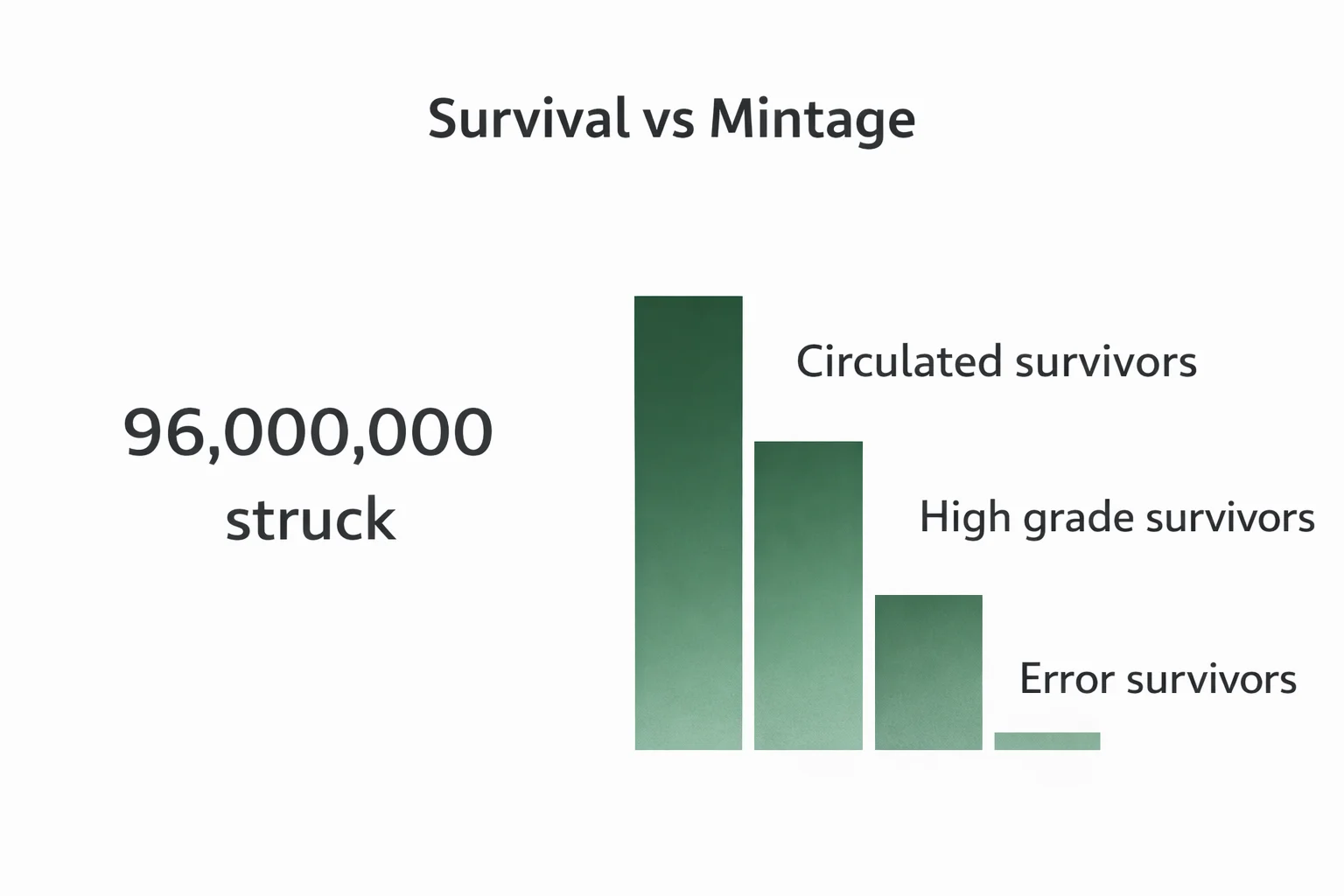
The mintage exceeded 96 million coins. Most circulated heavily. Many were melted. Few survived in pristine condition.
Error survival is even lower. Dies were replaced when damaged. Only limited numbers entered circulation before detection.
This explains why certain varieties are scarce despite high production.
Conclusion
This cent is not a key date by mintage. In worn condition, it remains accessible. However, specific errors and varieties do exist.
The Mexican gold off-metal strike stands at the top of the rarity scale. Double strikes, large cuds, and confirmed doubled dies follow. Repunched dates offer specialized interest.
Condition adds another layer. High-grade red examples can rival many errors in value.
The lesson is simple. Large mintage does not prevent rarity. Real scarcity comes from survival, die variation, and preservation.
In the end, the 1906 issue proves that even a common date can hide exceptional discoveries.